Cited but not mentioned, mentioned but not cited: the ghost-citation problem
 Michael Brown
September 14, 2026 • 10 min read
A customer asks an AI assistant for three good options. Your page appears in the supporting links, but your company never enters the answer. In another response, the assistant names your brand confidently, then sends the reader somewhere else. Both feel like a miss. They are different misses, and they have different fixes.
One is retrieval without recognition. The other is recognition without a route. Kevin Indig named the first pattern the ghost citation, and a study he ran with Semrush in June 2026 put numbers on how common it is.[1]
What the data shows
The study logged 3,981 domain appearances across 115 prompts in 14 countries on ChatGPT, Gemini, Google AI Overviews and Google AI Mode, classifying every appearance on two independent axes: was the domain cited, and was the brand named in the answer text.[1]
Of those appearances, 61.7% were ghost citations: the page was linked as a source and the brand was never named. A further 25.1% ran the other way, named with no citation attached. Only 13.2% achieved both.[1]
Those three figures sum to exactly 100, which is worth pausing on, because the study is usually quoted as "62% of AI citations are ghost citations." It is 61.7% of appearances. As a share of citations specifically the figure is higher, around 82%, since only 74.9% of appearances were cited at all. The looser phrasing has been repeated widely enough that you will see both numbers attributed to the same study.
The outcome every content team is optimising for happens in one appearance out of eight.
The citation rate across appearances was 74.9% and the mention rate 38.3%.[1] A link is roughly twice as likely as a name.
Geography moves it too. Brands were named in about half of AI answers in India and Sweden, against 18% to 22% in Italy, Brazil and the Netherlands.[1] A mention rate quoted without a country attached is close to meaningless.
Why the two signals come apart
The study's most useful finding is not a percentage. It is a pattern in who gets which outcome. Strong consumer brands were named more often than they were cited. Aggregators such as Wikipedia and Medium showed the opposite: heavily cited, rarely named.[1]
That split tells you what each signal is actually measuring. A citation is the evidence layer. The engine needed a source for a claim and your page served. It says your content was retrievable, relevant and good enough to support a statement. It says nothing about whether the model treats your company as a name worth saying.
A mention is the recognition layer. The model reaches for a name when that name is already the word the web uses for the thing being discussed. That is an entity property, built outside your site, and it is why a page can be quoted as evidence while its publisher stays invisible.
Which means the two problems do not share a fix. One is a content and retrieval problem. The other is a reputation problem, and reputation is not something you can edit into a title tag.
If you are cited but not mentioned
The usual advice here is on-site: put the brand name in the title, keep naming consistent, add organisation schema. Some of that is worth doing, but the correlation data says it is the weakest available lever.
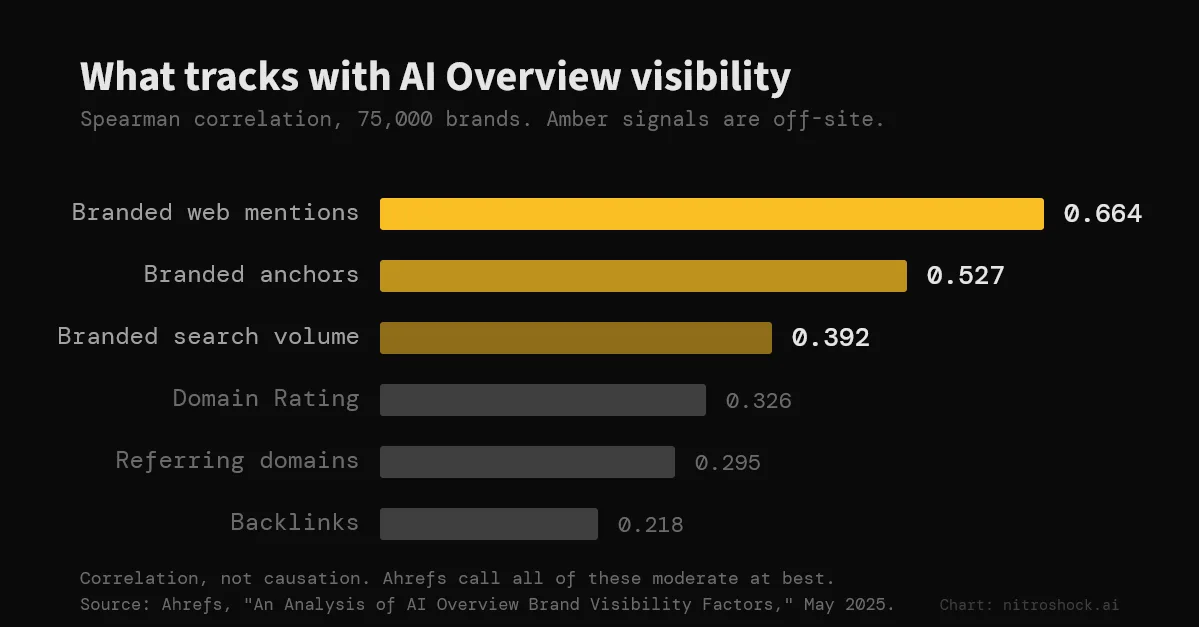
Ahrefs studied 75,000 brands with a Domain Rating above 40 and ranked which signals track with brand visibility in AI Overviews. Branded web mentions came top at 0.664 Spearman correlation. Branded anchor text followed at 0.527, branded search volume at 0.392. Domain Rating landed at 0.326, referring domains at 0.295, raw backlinks at 0.218 and content volume at 0.194. A December 2025 update put YouTube mentions higher still, around 0.737.[2]
Every signal at the top of that list is off-site. The things most sites spend their effort on, publishing volume and link count, sit at the bottom. The distribution is steep as well: brands in the top quartile for web mentions earned roughly ten times the AI Overview mentions of the next quartile down, and the bottom half were close to absent.[2]
Ahrefs are explicit that correlation is not causation and that the measured correlations are moderate at best. Read it as a direction, not a formula. But the direction is consistent: being named in AI answers tracks with being named elsewhere on the web, not with anything you can change inside your own HTML.
So the work is: get written about. Trade coverage, podcasts, supplier and partner pages, comparison and directory listings, conference talks, YouTube appearances, original data other people quote. Unlinked mentions count here, which is the part that surprises people who came up doing link building.
The on-site half still matters, and it is cheap. Give the page an author with a real identity. State the method behind a claim. Make the specific, attributable assertions that belong only to your business, such as an original count from work you actually did, rather than the generic framing anyone could have written. Keep the company name, description and authorship stable across the site so the entity resolves cleanly. Structured data can clarify a relationship that the visible page already supports. It cannot manufacture a reputation that does not exist.
If you are mentioned but not cited
How often this happens depends heavily on which assistant is answering. Ahrefs ran the question against its own brand, pulling more than 31,000 mentions of Ahrefs from a database of 150 million prompts, and measured how often a mention arrived with a link attached.[3]
| Platform | Mentions that included a link |
|---|---|
| Perplexity | 51.6% |
| Google AI Mode | 36.8% |
| ChatGPT | 26.9% |
| Copilot | 26.1% |
| Gemini | 16.8% |
| Google AI Overviews | 10.7% |
Read the caveat before you read the numbers. This is one brand, measured against itself, and Ahrefs is an unusually well-known name in its category. Treat the spread as real and the absolute values as one company's experience. The overall figure across all six platforms was 28%.[3]
Note also that these percentages are not comparable with the Semrush figures above, because the denominators differ. Ahrefs asks what share of mentions carried a link. Semrush asks what share of appearances were cited. Two studies can report a "citation rate" for the same engine and mean different things, which is most of why per-engine numbers in this field refuse to line up.
Ahrefs' more useful finding is what the link rate hides. Weight the same mentions by Google search volume, as a proxy for how many people see each answer, and the order changes.[3]
| Platform | Raw link rate | Weighted by query volume |
|---|---|---|
| Perplexity | 51.6% | 78.4% |
| Gemini | 16.8% | 71.3% |
| Google AI Mode | 36.8% | 46.2% |
| ChatGPT | 26.9% | 36.6% |
| Copilot | 26.1% | 31.7% |
| Google AI Overviews | 10.7% | 13.0% |
Gemini moves from second worst to second best, a jump of more than four times. The linked mentions were landing on high-volume queries, so exposure ran well ahead of what the raw percentage implied. A low link rate on prompts nobody types costs less than a low link rate on the prompts people actually use.
Ahrefs are careful about why. They have always targeted high-volume keywords, so they cannot say whether the platforms genuinely link more on popular queries or whether this is their own strategy showing up in the data.[3] Either way the lesson for measurement holds: weight your results by query popularity before deciding you have a problem.
Where you do have one, the work is closer to classic source design. The brand has entered the answer. The supporting page has not come with it.
Work through these in order:
- Confirm the engine can reach you at all. A page that returns 403 to a retrieval crawler cannot be cited no matter how good it is. Check with our free HTTP Header Checker and the AI Visibility Checker, and see our post on AI crawler access for the training and retrieval distinction.
- Make sure a page exists that directly supports the claim you are known for. Often there is not one, and the model is naming you from third-party coverage because your own site never made the argument.
- Put the load-bearing facts in HTML text, not in an image, a chart widget or a script-rendered component. Most AI crawlers do not execute JavaScript.
- Show the method, the date and the author where trust depends on them.
- Link internally from your service and topic pages to that evidence page, so it is the obvious destination for the claim.
- Give it a descriptive title and a stable URL, and stop changing them.
Improve the one page before publishing five more. Most small sites already have the expertise and have simply never packaged the proof in something retrievable.
Measuring it without fooling yourself
Track at the prompt level, and record mention and citation as separate columns rather than collapsing them into one visibility score. For each appearance, log the exact prompt, the engine, the country, the answer text, the cited URLs, the named brands and the date.
| Result | Share of appearances | What it means | Next action |
|---|---|---|---|
| Named and cited | 13.2% | Recognition and evidence aligned | Study what produced it, build adjacent coverage |
| Cited only | 61.7% | Content works, entity is quiet | Earn off-site mentions; clarify authorship and original evidence |
| Named only | 25.1% | Name is known, proof has no route | Build or fix the supporting page, confirm crawler access |
| Neither | Not measured | You did not appear, so there is no appearance to classify | Rework the answer and intent match before anything else |
The first three rows are shares of appearances and account for all of them. The fourth is your own most common result and the study cannot size it, because a domain that never surfaces never enters the sample. Treat it as the state you are trying to exit, not as a slice of the chart.
One caution about frequency. Sources behind AI answers turn over fast, and the published turnover figures range from severe to very severe depending on who measured and how. Reading your mention rate weekly and reacting to the movement will have you responding to sampling noise most of the time. Set a fixed prompt set, run it on a fixed schedule, and look at the trend across months rather than the delta across days.
The same applies to a single screenshot. One answer naming your brand is an anecdote. A repeated prompt set is a direction.
Our AI visibility tracking records mention and citation as separate signals across ChatGPT, Google AI Overviews, Gemini and Perplexity, on your own prompt set, so you can tell which of the two ghosts you are dealing with. Pay-per-use, no subscription.
A ghost citation is not a failure. It is a diagnostic. The page got into the room. One half of the introduction was missing, and which half it was tells you what to do next.
Sources
- Semrush with Kevin Indig, "The Ghost Citations Study," June 9, 2026. 3,981 domain appearances, 115 prompts, 14 countries, four engines, using the Semrush AI Visibility Toolkit. semrush.com
- Ahrefs, "An Analysis of AI Overview Brand Visibility Factors," 75,000 brands with Domain Rating above 40, Spearman correlation, published 2025 with a December 2025 update covering YouTube mentions.
- Mateusz Makosiewicz, "Do AI Assistants Link When Mentioning Brands? For Ahrefs, Only 28% of the Time," Ahrefs, published November 26, 2025, reviewed by Ryan Law. Over 31,000 mentions of the Ahrefs brand drawn from a 150 million prompt database via Brand Radar, across AI Overviews, AI Mode, ChatGPT, Perplexity, Copilot and Gemini. Single-brand study. ahrefs.com
Semrush and Ahrefs both sell AI visibility tracking, and both studies were produced with their own toolsets. The correlation figures in particular are observational and, as Ahrefs states, do not establish causation.