
Rank tracking answers one question that a single search cannot: is this moving, and in which direction. Checking your own position in Google tells you where you sit today. Tracking tells you whether last month's work did anything.
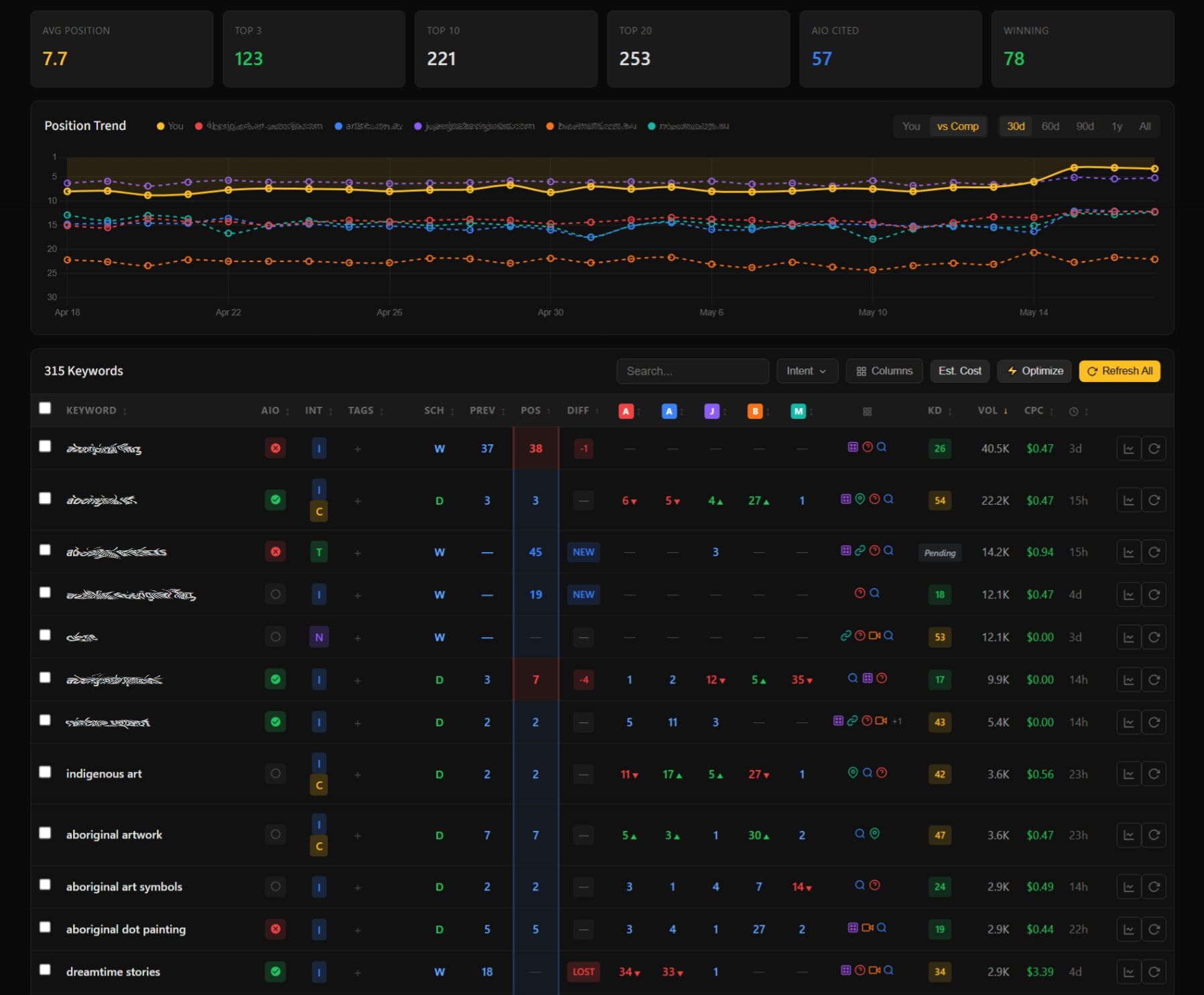
The short version
- What it does: records where your pages rank for chosen keywords, on a schedule, so you can see change rather than a snapshot.
- Where it runs: inside a project in your account, because tracking needs somewhere to store history. There is no public version of this and there cannot be.
- What it costs: credits per keyword check, not a subscription. No monthly fee, no charge per user, no charge for adding a domain. Credits never expire.
- Why that matters: you pay for checks you run. A paused client costs nothing, rather than costing a keyword slot every month until you remember to cancel.
What rank tracking actually tells you
A ranking is not a business outcome. Nobody has ever paid an invoice because a keyword moved from eleven to eight. What rank tracking gives you is a fast, cheap signal about whether something changed, and roughly when, which is what turns "traffic is down" into a question you can answer.
Three situations where it earns its cost.
After you publish or update something. You rewrote a page six weeks ago. Did it move? Without tracking you are comparing a memory to a feeling. With it you have a line on a chart and a date.
When traffic drops. The first useful question is whether you lost positions or kept them. Those are completely different problems. Lost positions means a ranking issue. Held positions with less traffic means the result page changed shape around you, which is increasingly common and needs a different fix entirely.
During a migration. This is the one where daily checking is genuinely worth the money. You want to know within a day if something broke, not at the end of the month.
Rank tracking is a diagnostic. It tells you where to look. It is not a scoreboard and treating it as one is how agencies end up reporting on numbers nobody is paying for.
Choosing what to track
This is where most rank tracking money is wasted, and it is worth more attention than the tool itself.
The instinct is to track everything. Every keyword the site touches, hundreds of them, on the theory that more data is better. What actually happens is that the report becomes unreadable, most of the movement is noise from keywords nobody searches with intent, and the handful of terms that matter get lost in the middle of it.
A better approach is to track keywords you would be willing to do work about. If a term dropped five places and your honest answer is "we would not change anything," it does not belong in the tracker. That question alone usually cuts a list by two thirds.
The terms worth the slot:
Money terms. The queries your buyers type when they are ready. Usually fewer than you think, often under twenty for a small business.
Terms you are close on. Positions roughly four through fifteen. This is where a small improvement produces a visible traffic change, and where tracking gives you the fastest feedback.
Terms you just targeted. Anything you published or rewrote in the last quarter, so you can tell whether the work landed.
A few competitor benchmarks. Terms where a competitor outranks you and you intend to do something about it.
What to leave out: your brand name, which will rank first regardless and tells you nothing; terms with no commercial relevance that happen to send traffic; and anything ranking beyond about fifty, where movement is mostly random and the distance to page one is a content project rather than a tracking problem.
How often to check
Weekly is the right default for almost everyone, and this is one of the few places where the pay-per-check model changes the honest answer.
On a subscription tracker you are paying for a keyword slot whether you look at it or not, so the tool checks daily because it costs the vendor little and looks generous. Daily data on a stable site is mostly noise. Positions fluctuate for reasons that have nothing to do with you: personalisation, testing, index churn, the result page being assembled slightly differently for different users. Reacting to a two-place daily wobble is how people end up changing pages that were fine.
Weekly smooths that out and still catches anything real within a few days. Monthly is too slow to connect a change to a cause, because too much happened in between.
Daily is worth the cost in three cases: during and after a site migration, while recovering from a manual action or a major algorithm update, and in the two weeks after a launch where you need to know quickly whether anything is indexing at all. Then go back to weekly.
Because you pay per check here, that pattern costs what it costs. Run daily for the fortnight you need it and weekly the rest of the year, and the bill reflects that rather than being flat.
Location and device change the answer
There is no such thing as "the" ranking for a keyword. There is a ranking for a person, in a place, on a device, and the differences are large enough that checking from the wrong place will mislead you.
Location matters most for anything with local intent, and more queries carry local intent than people expect. A search for a service can return a completely different result page in two cities in the same country. If you sell in Vancouver and check from a default US location, you are looking at somebody else's search results.
Device matters because mobile and desktop result pages are assembled differently, with different features taking up different amounts of space. A position that is fourth on both can mean visible on desktop and three scrolls down on mobile.
The practical rule: set location and device to match your actual customers, then leave those settings alone. Changing them mid-campaign breaks your history, because you are now comparing two different measurements and the chart will show a jump that never happened.
Why position alone stopped being enough
This is the part older rank trackers have not caught up with, and the reason this one records something extra.
A result page is no longer ten links. It can carry an AI Overview, a featured snippet, a local pack, product listings, video, and a large block of related questions, all sitting above the thing you rank for. Position four means something very different depending on how much of the screen is spent before anyone reaches it.
So each check here records whether Google returned an AI Overview for that query, alongside the position. That gives you a case a position column alone cannot explain: the ranking held perfectly steady, and traffic fell, because the result page grew a summary above you. Without that column, the data says nothing changed and your analytics says something did, and you spend a week looking for a ranking problem that does not exist.
It also shows you the reverse. If a keyword loses its AI Overview, clicks can return without your position moving at all.
How the pricing works
Rank tracking is normally sold by the keyword slot on a monthly subscription. You pick a plan with a keyword allowance, and you pay for that allowance every month regardless of how much of it you use or how often you look.
That model has two costs people notice late. Onboard a client in March and pause them in June, and the slots keep billing until somebody remembers to remove them. And team access is usually priced per seat, so the third person who needs to read a report costs more than the reports do.
Here you buy credits and spend them per keyword check. No monthly fee, no per-seat charge, no charge for creating a project or adding a domain. Credits never expire, so buying them is not a deadline.
Practically, that means a paused project costs nothing while paused. A client you check weekly costs a quarter of what a client you check daily costs, and you decide that per client rather than per plan. And an agency with six people reading reports pays the same as an agency with one.
Where a subscription is genuinely cheaper: very high volume, checked daily, forever. If you track thousands of keywords every day without pause, a flat rate may win. Most agencies do not do that, but it is worth doing the arithmetic on your own numbers rather than taking our word for it.
Rank tracking runs inside a project. Create a free account and you get 25 credits to try it with.
No card required. Credits never expire.
Common questions
Why can I not try this without an account?
Because tracking needs stored history to compare against, and history needs a project to live in. A single position lookup with nothing to compare it to would not tell you anything a search does not.
How many keywords should I track?
Fewer than you want to. Track terms you would act on. For most small businesses that is twenty to fifty; for an agency client, often under a hundred.
Why do my positions differ from what I see in my browser?
Your browser personalises results based on your history, location, and account. A tracker checks from a clean, specified location, which is closer to what a new visitor sees.
Do rankings vary between checks?
Some, yes. Small movements of a place or two are normal and usually not meaningful. Look for sustained direction over several checks rather than reacting to one.
Can I track competitors?
You can track the same keywords and see which URLs rank, which shows you competitor positions on the terms you care about.
What happens if I stop for a few months?
Nothing is billed while you are not checking, and your credits are still there when you come back. Your history stays in the project, with a gap in it for the period you skipped.
Do you offer a one-off lookup instead?
Yes. The Domain Analyzer returns a current snapshot for any domain without a project, which suits prospecting and competitor research. It is also credit-based, and it stores no history, so it answers "where does this sit now" rather than "is this moving."